

As a parent who believes in the value of education and fulfilling our personal childhood dreams, I have seen how our daily choices shape a child’s future. Indeed, the future of a child is not a distant dream—it’s a daily decision. With this in mind, every word spoken, every boundary set, and every environment shaped contributes to the outcome we call “the future”.
Moreover, acting with clarity and confidence assures our children’s safety and security, protecting them as they grow. When, therefore, we approach each decision with a clear sense of purpose and a steadfast commitment to our values, we create an environment where children feel safe and supported. As a result, this intentional way of parenting shields children from harm, as well as guides them confidently along their path forward. Consquently , this helps them to grow into resilient and empowered individuals.
In this context, the acronym FUTURE offers a compass to help us secure the path ahead for our children. By providing direction and clarity, this guides us in making choices that protect, nurture, and empower, ensuring every child the opportunity to thrive in a safe and loving environment.
The FUTURE Compass
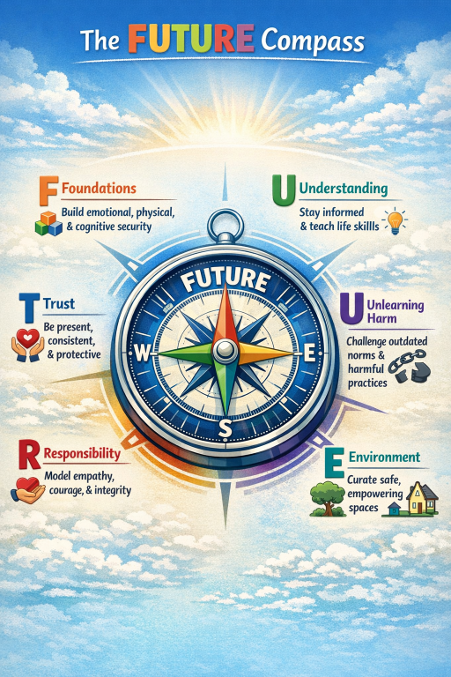
Picture is based on content by author and inspired by research.
| Letter | Principle | Actionable Focus |
| F | Foundation | Build emotional, physical, and cognitive security |
| U | Understanding | Stay informed and teach relevant life skills |
| T | Trust | Be present, consistent, and protective |
| U | Unlearning Harm | Challenge outdated norms and harmful practices |
| R | Responsibility | Model empathy, courage, and integrity |
| E | Environment | Curate safe, empowering spaces |
The FUTURE framework, outlined above is supported by recent research from the past decade on the topic. This framework aligns well with nurturing, evidence-based practices discussed in our last article which emphasizes love, safety, and inclusion. Full methodologies and results are available in the original studies listed at the end of this article.
Foundations: Building Security
Research has shown that when parents feel emotionally healthy and secure, their children benefit in profound ways (LaMonica et al., 2025). Indeed, children grow up stronger—emotionally, physically, and mentally—when we create safe and loving environments (ibid). As parents feel good about themselves, we’re more likely to practise positive parenting, offering praise and showing affection. This means that well-adjusted parents will influence their children positively.
Notably, the well-adjusted parents does not necessarily resort to harsh discipline like yelling or spanking. These individuals build home responsibly, ensuring that their children feel safe, have a good learning environment to growth and develop strong social skills. These children who are cared for by their well-adjusted parents often thrive as they adapt to their social environment and overcome challenge quite readily.
Consequently, we, as parents ,must continually adjust to the unpredictable rhythms of daily life. The challenges of life, some expected others unforeseen, require us to adapt our responses, whilst adhering to our core values, even when circumstances shift. We grow stronger and build resilience, as we adjust, adapt and and adhere, enabling us to create environments where our children can thrive, no matter how the world around us changes.
Unlearning Harm: Challenging Outdated Norms
Every parent is a member of the bigger community of caregivers. They hold the responsibility of continually reflecting on and challenging outdated or harmful practices. These practices include approaches that are unfavourable to the growth and development of children, such as beating, spanking or yelling, which do not serve the children’s best interests. Recent evidence shows that moving away from such approaches opens the doors to healthier outcomes.
Every child’s growth paths are determined by their social environment and upbringing. Therefore, they are always more ready to adapt to their environment than their adult caregivers and parents. Henceforth, parents and caregivers ought to learn to evolve, to meet the adaptive nature of children (Carl et al., 2024). These motivations encourage us to refine our attitudes and adjust our behaviours; as a result, we can confidently reduce children’s anxiety, depression, and poor academic performance while fostering healthier emotional and academic development. We must be willing to seek support when it is needed and stay open to fresh, evolving ideas. By doing so, we show our commitment to unlearning outdated perspectives and relearning better approaches—so that we can intentionally create environments where every child has the opportunity to flourish.
Responsibility: Modelling Empathy and Integrity
Our actions as parents and caregivers speak volumes. This can be observed when we model responsibility, empathy, courage, and integrity. Our attitude and actions shape the values and social skills of the next generation. Modern research identifies parental modelling as a key predictor of prosocial behaviour and ethical decision-making in children (Haley M LaMonica et al., 2025). By adjusting our own emotional responses, adapting to our children’s needs, and adhering to principles of kindness and honesty, we create a living example for our children to follow. This daily practice not only strengthens family bonds but also empowers children to become compassionate, responsible members of their communities.
Environment: Creating Safe, Empowering Spaces
Children flourish when they are surrounded by safety, encouragement, and opportunities to grow (Verifying…, no date). In fact, when families and communities come together to create nurturing spaces—whether at home or in the neighbourhood—children develop emotionally, physically, and socially. Furthermore, by making safety a priority, encouraging active participation, and upholding values of inclusion, we help every child feel respected and protected. These collective shared efforts build the foundation for lifelong wellbeing and healthy development.
🧭 Visual Model: FUTURE Wheel
Imagine a circular wheel with FUTURE at the centre. Each spoke represents one principle, radiating outward. Surrounding the wheel are three orbiting spheres—independent variables that influence the child’s future:
- 🧠 Parental Mental Health
- 📚 Access to Education
- 🏘️ Community Safety
These variables feed into the wheel, either reinforcing or weakening the spokes. The dependent variable is clear: the child’s future. And it is not negotiable.
Let this framework be your compass. Because securing the future of children isn’t just a goal—it’s a daily practice.
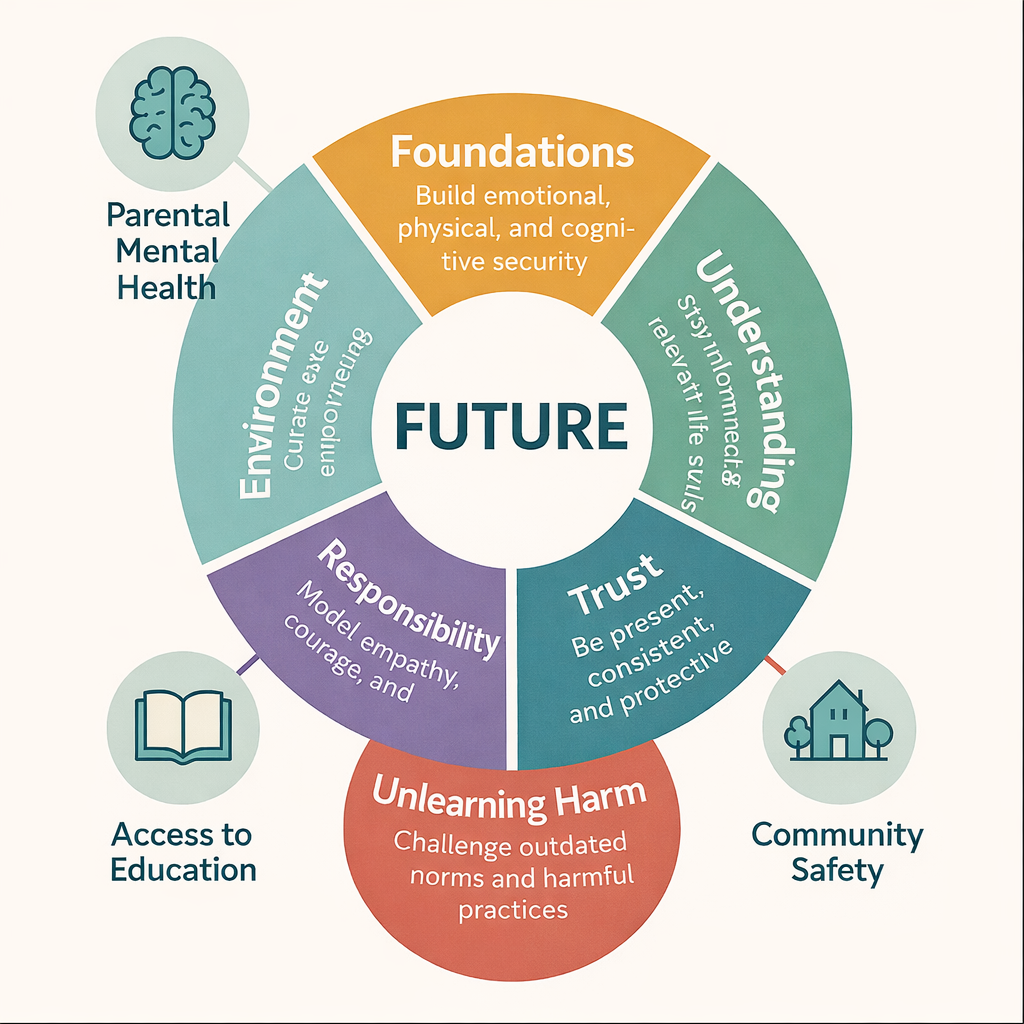
Image: Pic Prepared by Author Hanifa K. Cook
Foundations: Building Security
Research consistently shows that creating emotional, physical, and cognitive security for children leads to healthier development and long-term well-being. Secure foundations are associated with resilience, better learning outcomes, and social competence (Haley M LaMonica et al., 2025).
Understanding: Teaching Life Skills
Staying informed as a parent and passing on relevant life skills is vital. Studies highlight that children whose parents actively teach and model such skills are better equipped to navigate challenges, adapt to change, and thrive in diverse environments (Calderon-Villarreal et al., 2025; Haley M LaMonica et al., 2025).
Trust: Being Present and Consistent
Recent literature highlights the importance of trust This essentially means being a present, consistent, and protective caregiver is essential for a child’s emotional adjustment. Studies have shown that such engagement fosters attachment, reduces behavioral issues, and instills a deep sense of security (Steffel and Liu, no date; Haley M LaMonica et al., 2025).
Unlearning Harm: Challenging Outdated Norms
Another evidence of positive influence of the well-adjusted and presently committed parents can be seen from the willingness to challenge and move away from harmful or outdated parenting practices. These intentionally supports positive outcomes, whereby interventions that are focused on shifting parental attitudes and behaviors significantly reduce in negative outcomes such as anxiety, depression, and poor academic performance (Carl et al., 2024; Haley M LaMonica et al., 2025).
Responsibility: Modeling Empathy and Integrity
Modeling responsibility, empathy, courage, and integrity shapes children’s values and social functioning. Modern research identifies parental modeling as a key predictor of prosocial behavior and ethical decision-making in children (Haley M LaMonica et al., 2025 ;Calderon-Villarreal et al.,2025).
Environment: Creating Safe, Empowering Spaces
Safe, empowering environments contribute profoundly to healthy child development. Studies show that children prosper in communities with supportive social structures, physical safety, and opportunities for engagement (Verifying…, no date; Owens, 2025).
The Orbiting Variables: Key Influences
Research underscores that parental mental health directly influences both parenting quality and child well-being. Support for parental emotional adjustment leads to more responsive, nurturing childrearing practices, ultimately securing better developmental outcomes (Rocha et al., 2025; Steffel and Liu, no date; LaMonica et al., 2025).
Research also underscores that parental mental health directly influences both parenting quality and child well-being. In this regard, the parents themselves may seek emotional and mental support to help them in adjusting to their multi-faceted roles as parents, caregivers, leaders, and even career individuals. Such support can lead to more responsive, nurturing childrearing practices, ultimately securing better developmental outcomes.(Rocha et al., 2025; Steffel and Liu, no date; Haley M LaMonica et al., 2025)
Globally, access to quality education remains the single most powerful lever for breaking cycles of poverty and empowering future generations. Children with consistent educational opportunities show higher achievement, self-efficacy, and long-term economic success. (Children’s right to education – Humanium, 2025; 251M children and youth still out of school, despite decades of progress (UNESCO report), 2024).
Safe communities are fundamental. Recent studies highlight that when communities are safe and well-resourced, children exhibit higher social competence, reduced trauma, and robust developmental milestones (Owens, 2025; Verifying…, no date).
This nurturing, inclusive approach is in harmony with the ChildhoodSpeech visual brand—soft tones, rounded edges, and child-safe icons—signifying the loving, protective environment every child deserves.
Let this evidence-driven FUTURE framework be your family’s compass. Securing the future of children is not a distant aspiration—it’s a unified, daily practice, shaped by every decision, boundary, and word of encouragement (Verifying…, no date; Haley M LaMonica et al., 2025).
References and Bibliography
⁂251M children and youth still out of school, despite decades of progress (UNESCO report) (2024). https://www.unesco.org/en/articles/251m-children-and-youth-still-out-school-despite-decades-progress-unesco-report(Accessed: December 18, 2025).
Calderon-Villarreal, A. et al. (2025) ‘Parental involvement barriers and their influence on Student Self-Regulation in Primary education,’ Education and Urban Society, 57(4), pp. 327–346. https://doi.org/10.1177/00131245251314489.
Carl, T. et al. (2024) ‘Increasing parent help-seeking for child mental health: A study protocol for the growing minds check-in, an online universal screening tool,’ Contemporary Clinical Trials, 149, p. 107801. https://doi.org/10.1016/j.cct.2024.107801.
Children’s right to education – Humanium (2025). https://www.humanium.org/en/right-to-education/.
Hoang, N.-P.T. et al. (2024) ‘Place-based approach to support children’s development towards sustainable development goals: A scoping review of current effort and future agenda,’ Children and Youth Services Review, 164, p. 107873. https://doi.org/10.1016/j.childyouth.2024.107873.
LaMonica, H.M. et al. (2025) ‘Parental emotional adjustment as a primary target for parenting programs: a cross-sectional study,’ BMC Psychology, 13(1), p. 601. https://doi.org/10.1186/s40359-025-02646-8.
Owens, C. (2025) The Kids in Communities Study: what is it about where you live that makes a difference to children’s development? https://earlychildhoodmatters.online/2017/the-kids-in-communities-study-what-is-it-about-where-you-live-that-makes-a-difference-to-childrens-development/.
Poverty and its Impact on Students’ Education – NASSP (2019). https://www.nassp.org/poverty-and-its-impact-on-students-education/.
Rocha, S. et al. (2025) ‘The impact of parenthood on mental health within the academic community: highlighting vulnerabilities and identifying high-risk groups,’ Humanities and Social Sciences Communications, 12(1). https://doi.org/10.1057/s41599-025-05178-z.
Steffel, C. and Liu, Y. (no date) The Impact of Parental Mental health on Children’s Mental health in childhood and later adulthood: a systematic literature review. https://huskiecommons.lib.niu.edu/studentengagement-honorscapstones/1551.
Verifying… (no date). https://www.preventioninstitute.org/projects/cradle-community-focus-community-safety-and-healthy-child-development.
Welsh, B.C. et al. (2024) ‘Early Developmental Crime Prevention and Social Impact over the Life Course,’ The Annals of the American Academy of Political and Social Science, 714(1), pp. 74–96. https://doi.org/10.1177/00027162251341938.